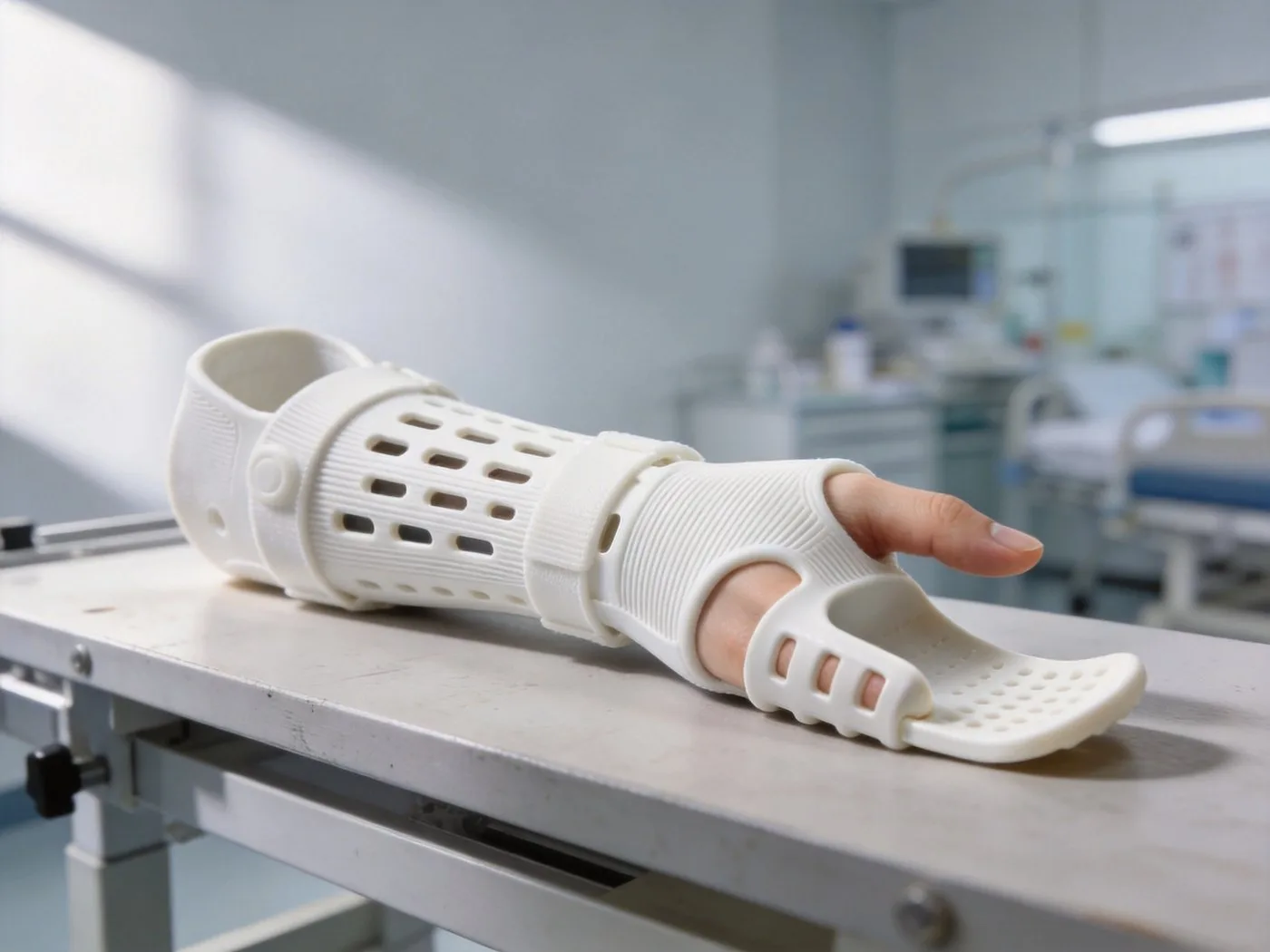
A new-generation 3D printing filament developed for medical brace applications. Safe composition, easy to use, reliable, with high print quality and high-speed printing. Tested to GB/T 16886 and ISO 10993 for skin-contact safety.
Values are typical figures published by AddiMaker, measured in the X-Y (in-plane) direction. FDM parts are usually markedly weaker between layers (Z), so allow margin along the real load path; moisture-sensitive grades (PA / PET / PC) must be dried before printing.
Density
1.25 g/cm³
Water absorption
0.02 %
HDT (0.45 MPa)
54 ℃
Tensile strength (X-Y)
35 MPa
Elongation at break (X-Y)
>40 %
Flexural strength (X-Y)
23 MPa
Where it sits in the range
HDT (0.45 MPa) 54℃: 2 of 2 in its family, 22 of 24 across the range.
Tensile strength (X-Y) 35MPa: 2 of 2 in its family, 19 of 24 across the range.
Density 1.25 g/cm³ — in the middle of the range.
Where it is used
The parts this material is most often asked to print in real projects.
Medical braces, orthoses and immobilisation devices
Rehabilitation aids and wearable devices
Custom parts in long-term skin contact
Who buys it
Industries and teams that typically order this material — use it to check the fit for your project.
Illustration of the part types and use cases typical for this material — not a photograph of shipped parts.
When to choose it — and when not to
Read the "Not suitable for" column first. If your project lands there, changing material is far cheaper than tuning parameters.
Suitable for
Medical braces, orthoses and splints (tested to GB/T 16886 and ISO 10993 for skin contact)
Rehabilitation aids and post-operative immobilisers
Custom-fitting parts in prolonged skin contact
Wearable structures needing some rigidity
Not suitable for
Primary load-bearing structure
High-temperature sterilisation unless the cycle has been validated
General industrial parts — the cost does not justify it
Long-term outdoor UV exposure
Where to go when this grade is not enoughSofter and more conformable → TPU95A or PEBA. Load-bearing → PAHT.
Printing and post-processing
Parameters are set against the VULCAN platform limits — nozzle up to 525 °C, bed up to 150 °C, chamber up to 150 °C held constant — so every value below runs on our machines as written. Still print a temperature tower and flow calibration on your first part, then lock the batch recipe.
Drying
60 °C / 4 h
Nozzle
220–240 °C
Bed
60 °C
Chamber
Not required
Speed
40–70 mm/s
Support
Soluble or clean-peeling — avoid marks on skin-contact faces
Post-processing
Every skin-contact edge must be rounded and sealed
Post-processingCan do: sanding, polishing, edge rounding, bonding, light heat forming. Cannot do: solvent polishing — it may compromise biocompatibility.
Other materials in this family
Characteristics and key data for the rest of the family; select a name to open its page.
Send your printer, volume, service temperature and lead time to the address below; we reply with alternative material options as well. sale@addimaker.com